
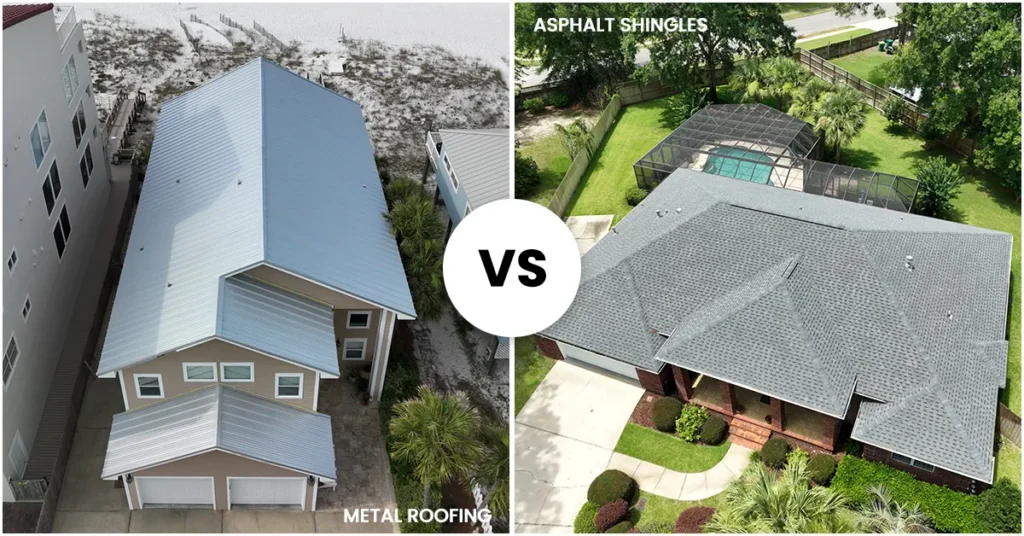
In the Florida Panhandle’s coastal environment, metal roofing outperforms asphalt shingles on wind resistance, longevity, salt air durability, and long-term insurance positioning. Asphalt shingles cost less upfront and remain the right choice when the budget constraint is real, the ownership horizon is short, or HOA requirements restrict metal roofing. For homeowners who plan to stay in their property for 20 or more years, live in a coastal or near-coastal location, or face insurance pressure tied to roof age, the long-term value case for metal roofing is strong. Neither material is right for every situation, and the right answer depends on your specific property, your plans, and your budget.
Key Takeaways
- Metal roofing lasts 40 to 70 years in Florida’s climate. Asphalt shingles typically last 15 to 25 years.
- Wind resistance favors standing seam metal, particularly at Gulf-adjacent locations.
- Salt air and UV intensity make the longevity gap between the two materials wider here than in inland markets.
- Florida’s insurance market increasingly distinguishes between metal and shingle roofs on wind mitigation.
- Upfront cost favors asphalt shingles. Long-term cost on a 20-plus year horizon often favors metal.
We have had this comparison conversation with homeowners across the Florida Panhandle for years. The right answer is rarely the same twice, because the conditions that make metal roofing the clear choice for one property are not always present on the next one. What we can do here is lay out how the materials actually differ and which factors should carry the most weight in this specific market.
What Most Homeowners Get Wrong About This Comparison
The most common mistake is treating the comparison as a simple price question. “Metal costs more, so I’ll go with shingles” assumes the total cost of ownership is the same over the life of the property. It is not. A shingle roof replaced today may need replacement again in 15 to 20 years in the Florida Panhandle’s climate. A metal roof installed today is designed to last 40 to 70 years. The homeowner who plans to own their property for 30 years and chooses shingles to save money today may very well pay for two full roof replacements within that window.
The second mistake is applying national averages to a coastal Florida market. Generic comparisons of metal versus shingles describe conditions that do not match what a roof on the Gulf Coast actually experiences. Salt air carried inland from the Gulf, UV intensity among the highest in the continental United States, and hurricane-force wind exposure are not present in the markets where most published roof lifespan data was collected. The performance gap between metal and shingles is more pronounced here than the averages suggest.
How Metal Roofing and Asphalt Shingles Actually Compare
Wind resistance. Modern architectural shingles are engineered to meet Florida Building Code wind resistance requirements, and they do, at their rated wind speeds. Standing seam metal roofing handles wind uplift differently. The interlocking concealed-seam design distributes wind loads in a way that exposed-fastener systems and shingle nail patterns do not. Post-hurricane damage assessments consistently show standing seam as one of the better-performing residential roofing systems in high-wind events. For properties in coastal or near-coastal locations where wind exposure is meaningful, that difference matters.
Longevity in the Florida Panhandle. Asphalt shingles degrade through UV-driven bitumen drying, granule loss, and moisture cycling. In Florida’s coastal environment, each of those mechanisms operates at accelerated rates: higher UV intensity, salt air carried from the Gulf that affects surface adhesion, and high year-round humidity. A well-installed shingle roof in this market realistically reaches the end of its functional life in 15 to 25 years. Metal roofing does not have these failure modes. The surface does not depend on a granule layer for UV protection and does not have bitumen to dry out. Metal roofing installed in the Panhandle routinely lasts 40 to 70 years with proper maintenance.
Salt air and coastal durability. This is where the comparison shifts most clearly in favor of metal for coastal and near-coastal properties. Asphalt shingles are organic composite materials, and salt air accelerates the degradation of the adhesive layer and the surface granules over time. Metal roofing, particularly aluminum and properly coated steel, handles salt air without the same progressive degradation. The further a property is from the Gulf shoreline, the smaller this advantage becomes, but it is relevant throughout the Panhandle service area.
Insurance positioning in Florida. Florida’s insurance market has created a practical dimension to this comparison that does not exist in most other states. Florida Statute 627.7011 allows insurers to require an inspection for roofs 15 years or older and to refuse renewal if the inspection shows less than 5 years of useful life remaining. Many Panhandle homeowners have already received non-renewal notices or premium increases tied to roof age. Metal roofing removes this pressure because a properly installed metal roof is not approaching the threshold insurers scrutinize within any reasonable ownership horizon. Beyond the age issue, metal roofing’s wind resistance properties are recognized in the wind mitigation inspection process, and properties with qualifying metal roofs often receive favorable premium treatment. Our metal roof installation page covers how we document wind mitigation features as part of the installation process.
Upfront cost. Asphalt shingles are less expensive to install. The material costs less, installation is faster, and the total project cost will be lower on an equivalent roof. For homeowners where budget is the binding constraint, this is a real advantage that the other factors do not erase.
Aesthetics. Both materials are available in a wide range of colors and profiles. Asphalt shingles are the familiar standard residential profile, and some communities require them by HOA rule.. Metal shingles are available for homeowners who want metal performance in a profile that presents as traditional residential. Standing seam has a distinct appearance that some homeowners prefer and others do not. Both materials have legitimate aesthetic choices available.
The Factors That Should Drive Your Decision
Ownership horizon. If you plan to stay in the property for 20 or more years, the long-term case for metal roofing becomes strong in this market. If you plan to sell within five years, the upfront cost premium is harder to fully recover, and shingles may be the more practical choice.
Location and wind exposure. The closer the property is to the Gulf and the more direct its wind exposure, the stronger the case for standing seam metal in particular. Properties further inland with lower salt air and wind exposure still benefit from metal roofing’s longevity, but the performance gap with shingles is somewhat narrower.
Insurance situation. If your current roof is approaching or past 15 years, or if you have already received non-renewal or premium increase notices, a metal roof replacement addresses the insurance issue completely rather than buying another window of shingle life.
Budget. An honest conversation about budget is part of every estimate we provide. Metal roofing is the better long-term investment for many Panhandle homeowners, but if the upfront cost creates real financial strain, a quality shingle installation is still the right answer for that situation.
For a full breakdown of what metal roofing costs in this market, see our metal roofing cost guide.
What Happens When You Choose the Wrong System for Your Situation
Choosing metal roofing when the budget does not support it creates financial strain that does not serve anyone well. Choosing the cheapest metal roofing option to close the price gap with shingles often means a system not well matched to the wind exposure, or a contractor without specific metal roofing experience cutting costs in ways that become visible a few years later.
Choosing shingles when the insurance situation demands a new roof, and then discovering that the insurer’s requirements have changed again before the new shingle roof reaches the end of its life, is a pattern we see frequently. The homeowner who replaces their 18-year-old shingle roof with a new shingle roof expecting 20 more years of insurance stability may be surprised by what the market looks like in 10 years.
The homeowners with the best outcomes are the ones who considered both options clearly, matched the choice to their actual situation, and selected a contractor with the experience to execute the system they chose at the quality level the system requires.
Why How a Contractor Approaches This Comparison Matters
How a contractor frames the metal versus shingles comparison tells you a lot about how they operate. A contractor who tells every homeowner metal roofing is always the right answer regardless of the situation is not giving honest advice. A contractor who quotes shingles by default because it is easier to install is not serving the homeowner’s long-term interests when metal would clearly be the better choice.
What a contractor who approaches this comparison correctly actually does: they ask about the homeowner’s ownership plans, their insurance situation, their budget, and their priorities before making a recommendation. They explain the trade-offs for the specific property and the specific conditions, not for a generic homeowner in a generic market. They are willing to recommend shingles when shingles are the right answer and metal when metal is the right answer, and they can explain why.
We have given estimates where we recommended shingles. We have also given estimates where we explained clearly that the homeowner’s current insurance situation and ownership plans made metal roofing the obvious choice even with the higher upfront cost. The recommendation follows the facts of the situation, not what is easier to install or what has the higher margin.
The Bottom Line
In the Florida Panhandle, metal roofing outperforms asphalt shingles on the dimensions that matter most in a coastal environment: wind resistance, longevity, salt air durability, and insurance positioning. Asphalt shingles have a real upfront cost advantage and remain the right choice in specific situations. The comparison that matters is not metal versus shingles in the abstract. It is which system makes more sense for your property, your plans, and your situation.
If you want a direct, honest conversation about which system is the right choice for your specific roof, we offer free estimates with no obligation. Get Your Free Estimate
Frequently Asked Questions
Do metal roofs actually hold up better in hurricanes than shingles?
Standing seam metal roofing generally performs better in high-wind events than asphalt shingles. The concealed fastener interlocking seam design distributes wind uplift loads differently than a shingle nail pattern. Post-hurricane damage assessments in Florida consistently show standing seam as one of the better-performing residential systems in high-wind conditions. Exposed-fastener metal panel systems perform differently and the comparison is less clear-cut for those products.
How long do asphalt shingles actually last in Florida’s climate?
In the Florida Panhandle’s coastal environment, a well-installed architectural shingle roof realistically reaches the end of its functional life in 15 to 25 years. High UV intensity, salt air, and the humidity and moisture cycling of a coastal climate all accelerate the degradation mechanisms that determine shingle lifespan. This is meaningfully shorter than the 25 to 30-year figures often cited for shingles in other markets.
Will a metal roof make my home hotter in summer?
No. Metal roofing reflects solar radiant heat rather than absorbing it the way dark asphalt shingles do. Properly installed metal roofing with appropriate underlayment generally performs as well or better than asphalt shingles on summer cooling load. Florida homeowners whose prior concern was a metal roof making the home hotter have this backwards: metal reflects heat, asphalt absorbs it.
Does adding a metal roof increase home resale value?
A new metal roof adds value through its impact on the buyer’s insurance situation and maintenance cost expectations, both of which are significant in the current Florida market. A buyer who would face a near-term shingle replacement or an insurer scrutinizing the roof age is in a better position with a property that has a recently installed metal roof. The specific value impact depends on the market and the buyer, but the insurance situation in Florida has made a sound, newer roof more relevant to buyers than it was five years ago.
Is metal roofing appropriate for all house styles?
Standing seam metal roofing has a distinct contemporary appearance that suits some architectural styles better than some. Metal shingles are available for homeowners who want metal performance in a profile that presents as traditional residential roofing. Some HOA agreements specify roofing materials; it is worth confirming community requirements before committing to a system. Beyond aesthetics, the roof geometry matters: metal roofing is appropriate for most standard residential pitches and works particularly well on hip roofs common in the Panhandle.
Related Reading
- What Is Metal Roofing?
- How to Choose a Metal Roofing Contractor
- How Much Does Metal Roofing Cost?
- Metal Roof Installation