
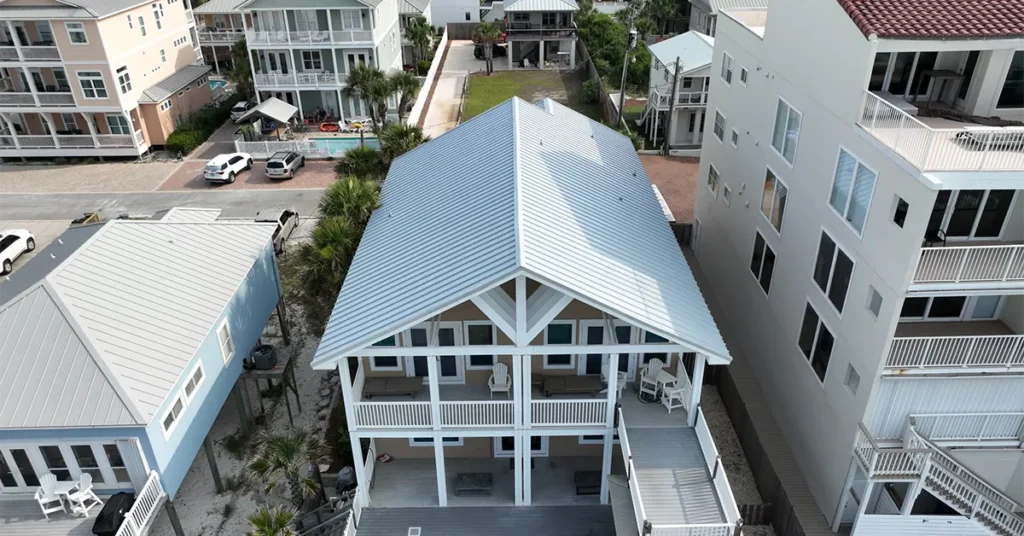
Choosing a metal roofing contractor in Florida starts with verifying a valid Florida Certified Contractor (CCC prefix) license through the DBPR, then confirming active general liability and workers’ compensation insurance. Beyond licensing and insurance, the key question is specific metal roofing experience: how many metal installations has the contractor completed, and on what system types? Metal roofing installation requires different knowledge than asphalt shingles, and general roofing experience does not substitute for it. Manufacturer certifications, written proposals specifying materials and scope, and a clear answer to who will be on the roof are the remaining filters that separate contractors worth hiring from those worth avoiding.
Key Takeaways
- Florida Certified Contractor (CCC license) is the gold standard. Registered contractors are county-specific; certified contractors can work statewide.
- Verify insurance certificates directly. Do not accept verbal assurance.
- Ask specifically about metal roofing installations. Not shingles. Metal.
- Manufacturer certifications like Owens Corning Preferred are independently verifiable.
- Written proposals that specify scope, materials, and warranty terms are not optional.
After years of working in this industry, we have seen what happens when homeowners treat metal roofing as interchangeable with any other roofing project. The roof looks fine at first. The problems surface one to three years later, when flashing details start failing, when panel movement from thermal expansion was never accounted for, when fastener washers degrade because exposed-fastener systems were not the right choice for the location. Those repairs cost more than hiring the right contractor from the start would have.
What Most Homeowners Get Wrong When Hiring a Roofer
The most common mistake is treating roofing as a commodity and using price as the primary filter. The lowest bid on a metal roofing project usually reflects one of two things: lower material quality, or a crew without specific metal roofing experience working faster than the job warrants. Neither produces the outcome the homeowner is paying for.
The second mistake is not distinguishing between general roofing experience and metal roofing experience. A contractor who has installed thousands of asphalt shingle roofs has genuine roofing expertise, but metal roofing involves different fastening systems, different thermal expansion management, different flashing requirements, and different installation sequencing. The skills do not fully transfer. Asking “how many roofs have you done?” without specifying metal roofing does not give you the information you actually need.
The Right Way to Vet a Metal Roofing Contractor
Step 1:
Verify the Florida license. Florida requires roofing contractors to hold a state-issued license. A Certified Contractor (CCC prefix) is licensed to work throughout Florida and must carry roofing insurance and meet state-level competency requirements. A Registered Contractor is licensed to operate only within a specific city or county. You can verify any license through the Florida Department of Business and Professional Regulation at myfloridalicense.com. The license number should appear on the contractor’s website, their estimate documents, and their marketing materials. If you cannot find a license number, that is a significant red flag.
Step 2:
Request and review insurance certificates. Ask for certificates of insurance for both general liability and workers’ compensation before any contractor sets foot on your property. General liability covers property damage during the course of the work. Workers’ compensation covers crew injuries on your property. If either is absent and an incident occurs, you can face liability as the property owner. Request the actual certificate, not verbal assurance, and check that the coverage dates are current.
Step 3:
Ask specifically about metal roofing experience. How many metal roofing installations has this contractor completed in the last two years? What systems do they work with regularly? Have they installed on roofs with similar complexity to your property? Can they provide references for completed metal projects you can contact? A contractor who answers these questions readily and specifically is in a different category from one who pivots back to total roofing experience.
Step 4:
Check manufacturer certifications. Programs like Owens Corning’s Preferred Contractor designation require contractors to demonstrate installation quality, maintain licensing and insurance, and meet defined training and volume criteria. These certifications are independently verifiable through the manufacturer’s website. They are not guarantees, but they are external confirmation that the contractor has met a defined quality standard beyond their own marketing.
Step 5:
Compare written proposals on equal terms. Any legitimate contractor provides a written proposal before work begins. The proposal must specify the exact scope of work, the materials to be used (system type, panel gauge, coating), warranty terms from both the contractor and the manufacturer, the payment schedule, and the project timeline. If you are comparing proposals, ensure each covers the same scope. A proposal that does not include deck inspection and repair looks less expensive until the crew finds deck damage mid-project.
What Separates a Qualified Metal Roofing Contractor From a General Roofer
The technical details that determine whether a metal roof performs over its intended lifespan are not visible to the homeowner during installation. Flashing at penetrations and transitions. Fastener selection and placement on exposed-fastener systems. Thermal expansion accommodation on longer panel runs, which matters in Florida’s temperature range. Underlayment specification for the specific climate. Seam locking technique on standing seam systems.
A contractor with genuine metal roofing experience treats these details as standard practice. A contractor applying shingle installation habits to a metal roofing project will get some of them right by accident and miss others in ways that become visible later.
Warning signs worth taking seriously: pressure to sign immediately, large upfront deposits that exceed a reasonable materials deposit, door-to-door solicitation after a storm, no physical business address or verifiable local presence, and any resistance to providing a detailed written scope before work begins. Post-storm contractor surges in the Panhandle are a known pattern. The time pressure that follows a hurricane is exactly when homeowners most need to slow down and verify the basics.
Our metal roof installation page covers what a complete and correctly scoped metal roofing project looks like from estimate through completion.
What Happens When You Hire the Wrong Contractor
Metal roofing installation errors do not usually announce themselves at completion. They surface over the following one to five years as small problems that compound. A flashing detail that is slightly off leaks intermittently before it leaks consistently. Fastener washers on an exposed-fastener system installed in a high-UV environment start degrading by year three or four. Panels that were not allowed to expand and contract properly begin working against the substrate.
The compounding effect matters because water intrusion in a roof system causes damage downstream of the entry point. By the time a homeowner traces the source, the repair scope has grown beyond what it would have been if the original installation had been done correctly. We have taken on repair work on metal roofs installed by other contractors, and the pattern is consistent: small installation shortcuts that looked fine at completion become expensive several years later.
Why How a Contractor Approaches Metal Roofing Matters
The standard approach in much of the roofing industry is to separate the sales function from the installation function. A sales representative estimates and closes the job; an installation crew does the work; warranty questions go to a third contact. That chain works for commodity roofing, but it creates accountability gaps on a 40-to-70-year system where the details at installation determine the outcome.
What a contractor who approaches metal roofing correctly actually does: the same person who walks the roof, reviews the deck condition, discusses system options with the homeowner, and writes the proposal stays involved through completion. The system selection is matched to the property and the wind exposure, not to what is in inventory or what was ordered for the previous job. Flashing details are not improvised around existing penetrations but planned from the estimate. The crew understands the specific system being installed, not just roofing in general.
We handle every metal roofing estimate personally and stay involved from estimate through completion. Our installations are backed by Owens Corning Preferred Contractor certification, which is independently verifiable through Owens Corning’s contractor directory. That is not a boast; it is a way of saying that our quality standard has an external check, not just our own word.
The Bottom Line
Hiring a metal roofing contractor in Florida comes down to five verifiable things: a valid Florida CCC license, active insurance certificates, demonstrated metal roofing experience specifically, a written proposal with full scope and materials specified, and a clear answer to who is accountable from estimate through warranty. Homeowners who use these filters choose from a much shorter list than homeowners who compare bids on price alone, and the results are consistently different.
If you are evaluating contractors in the Florida Panhandle and want to compare notes on what a metal roofing project proposal should contain, we are glad to provide a free estimate and answer your questions. Schedule a Free Roof Inspection
Frequently Asked Questions
What Florida license should a metal roofing contractor have?
A Florida Certified Contractor license with a CCC prefix is the appropriate credential for roofing work statewide. You can verify any contractor’s license number and current status at myfloridalicense.com. A Registered Contractor license (RC prefix) is limited to a specific city or county and may not be valid for work at your location.
Is a written contract required for roofing work in Florida?
Florida law requires written contracts for home improvement work above certain thresholds, and roofing projects well exceed those thresholds. Beyond the legal requirement, a written contract is your primary protection if a dispute arises about scope, materials, or workmanship. Never allow roofing work to begin without a signed written contract that specifies the materials, scope, payment schedule, and warranty terms.
How large of a deposit is normal for a metal roofing project?
A reasonable deposit covers material ordering and scheduling, typically somewhere in the range of 10 to 30 percent depending on the contractor and project size. A demand for 50 percent or more of the total cost before work begins is outside the normal range and worth questioning. Florida law places limits on deposit amounts for certain home improvement contracts.
What is an Owens Corning Preferred Contractor?
Owens Corning’s Preferred Contractor designation is a manufacturer-verified certification that requires contractors to demonstrate installation quality, maintain appropriate licensing and insurance, and meet defined volume and training criteria. You can verify whether a contractor holds this certification at owenscorning.com. It is not a guarantee of outcome, but it is an independent confirmation of a defined quality standard.
Should I get multiple estimates for a metal roofing project?
Yes. Getting two to three estimates is standard practice and provides useful information about scope, materials, and pricing in the local market. When comparing estimates, compare them on equivalent scope, not just on total price. An estimate that omits deck inspection, specifies lighter-gauge materials, or does not include a detailed warranty description is not comparable to one that covers these items.
Related Reading
- What Is Metal Roofing?
- How Much Does Metal Roofing Cost?
- Metal Roofing vs. Asphalt Shingles
- Metal Roof Installation