
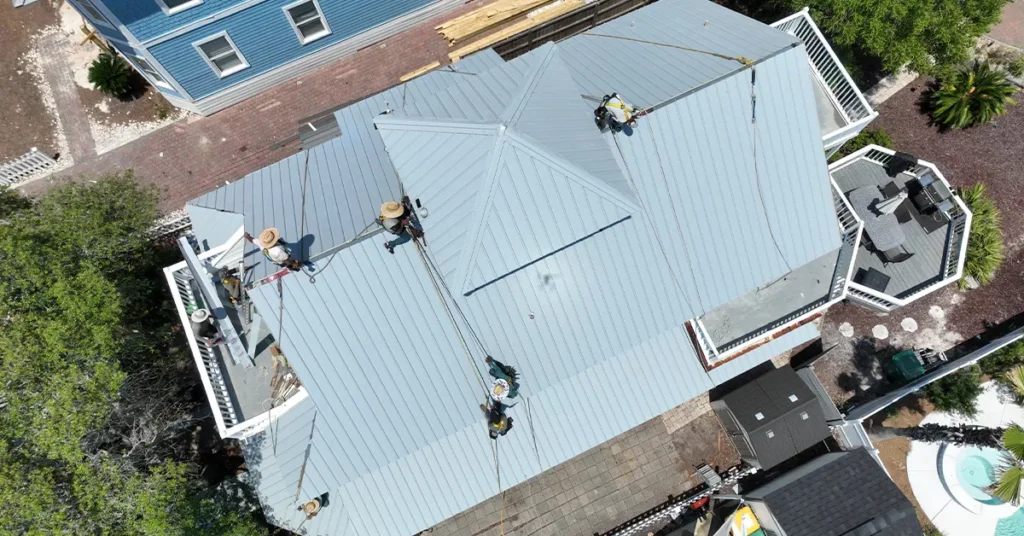
Metal roofing costs more upfront than asphalt shingles. For residential projects in the Florida Panhandle, standing seam metal roofing typically runs in the range of $12 to $18 per square foot installed, while corrugated and ribbed panel systems come in lower, often $7 to $12 per square foot installed depending on the system and site conditions. Asphalt shingle replacement in the same market typically runs $5 to $9 per square foot installed. The upfront gap is real. The long-term case for metal roofing rests on a lifespan of 40 to 70 years versus 15 to 25 years for shingles in Florida’s coastal environment, and on the insurance and wind mitigation benefits that metal roofing carries in this state. No article can tell you what your specific roof will cost. That number requires someone to walk your roof.
Key Takeaways
- Standing seam runs higher than corrugated panels. Both are priced per square foot installed, including labor and materials.
- Roof size, pitch complexity, deck condition, and system type are the four biggest cost drivers.
- Tear-off of existing roofing adds to the total. Overlay installations save that cost when the deck supports it.
- The long-term value case for metal roofing requires factoring in lifespan, maintenance, and insurance impact.
- Price per square foot comparisons are only valid when the scope is identical.
After years of providing estimates across the Florida Panhandle, we know the question homeowners most want answered before they call is what a metal roof is actually going to cost them. We are going to give you real numbers, explain what drives them, and be clear about what no article can tell you.
What Most Homeowners Get Wrong About Metal Roofing Costs
The most common mistake is comparing metal roofing prices to shingle prices in isolation without accounting for the difference in what those prices buy over time. A homeowner who looks at the per-square-foot gap between a metal roof and a shingle roof and concludes the shingle is obviously better value is doing math on one number while ignoring the others that determine the real cost of owning a roof.
A shingle roof installed in the Florida Panhandle today may need replacement in 15 to 20 years, depending on sun exposure, salt air proximity, and maintenance. A metal roof installed today is expected to last 40 to 70 years. On a long enough ownership horizon, the total cost of two shingle roofs often exceeds the cost of one metal roof, before accounting for the difference in maintenance costs, insurance treatment, and the disruption of going through a full replacement twice.
The second mistake is treating per-square-foot price comparisons as meaningful when the scope differs. A bid that skips deck inspection, uses lighter-gauge panels, or does not include proper flashing at penetrations is not the same product as one that covers these items, even if the headline number is lower.
What Metal Roofing Actually Costs and Why
For residential installations in the Florida Panhandle market, these are the installed cost ranges we see, based on current material and labor conditions:
Standing seam metal roofing: $12 to $18 per square foot installed on a standard residential roof with a straightforward pitch and deck in sound condition. Standing seam commands a higher price because the panels, the installation tooling, and the labor skill required are all more demanding than exposed-fastener systems. The concealed fastener design eliminates the maintenance liability of exposed fastener washers, which is a meaningful long-term value element in a high-UV environment.
Corrugated and ribbed metal panels: $7 to $12 per square foot installed, depending on the panel specification and the roof geometry. These systems are appropriate for many residential applications, and the lower price reflects a more straightforward installation process rather than inferior performance in appropriate use cases.
Metal shingles: Generally between the two panel types in cost, roughly $9 to $14 per square foot installed, depending on the specific product and the installation complexity.
For comparison, asphalt shingle replacement in this market currently runs approximately $5 to $9 per square foot installed, depending on the shingle class, the roof geometry, and the deck condition.
These ranges carry real variance and should be understood as context, not as a substitute for an actual estimate on your property. Roof complexity, access conditions, and the specific system details affect the final number in ways that a range cannot capture.
Our metal roof installation page covers what a complete metal roofing project includes from estimate through completion.
What Drives the Final Number on Your Specific Project
Roof size and geometry. Roofing is priced by the square (100 square feet). Your roof’s actual square footage, including waste factors for valleys, hips, and cuts, determines the material quantity. Hip roofs, which are common in the Panhandle for their wind resistance, require more cuts and more waste than simple gable roofs, and that waste factor affects the material cost.
Pitch. Steeper pitches require more time and care during installation. Crew mobility is slower, panel placement takes longer, and the fall protection requirements increase with pitch. Projects with pitches above 8:12 typically carry a pitch premium.
Deck condition. When the existing roofing is removed, the deck is inspected. Deck repairs, when needed, are priced separately from the roofing installation because the extent of damage is not fully known until tear-off is complete. Properties with roofs that have experienced any moisture intrusion often have some deck repair in scope. We identify what we can visually before tear-off and communicate anything that becomes visible during the process.
Tear-off versus overlay. Most metal roofing installations require full tear-off of the existing system. Tear-off adds labor and disposal costs to the project total. In cases where the deck is in sound condition and only one existing shingle layer is present, an overlay installation may be appropriate and saves the tear-off cost. We evaluate this during the estimate.
System selection. Standing seam costs more than corrugated panels, and both cost more than asphalt shingles. The system that is right for your property depends on your wind exposure, your roof geometry, your aesthetic preferences, and your budget. We walk through the trade-offs for your specific situation during the estimate.
Material market conditions. Tariffs on imported steel and aluminum in 2025 introduced cost volatility into the metal roofing materials market. Current pricing reflects those conditions. We provide current material pricing in our estimates rather than quoting from ranges that may be outdated.
What Happens When You Choose Based on Price Alone
We have provided estimates where we were not the lowest number, and we have subsequently been called to provide repair work on properties where the lowest bid was awarded. The pattern is consistent: the installations that produce repair calls two to five years later share a set of characteristics. Flashing details handled improperly. Panel gauge lighter than the exposure warranted. Fastener washers on exposed-fastener systems that were the wrong type for the UV environment. Deck damage that was present at tear-off but was not repaired before the new system went on.
None of these failures are visible to the homeowner at installation. They become visible later, through leaks that do not announce their source clearly, through panels that begin working against the substrate over multiple thermal cycles, through repair costs that exceed what the price difference from the original estimate would have been.
The other category is homeowners who received what they thought was a metal roofing estimate and received an asphalt shingle estimate using one line of “metal option” language that was never clarified. Reading the scope of work in any proposal before signing is not optional.
Why How a Contractor Quotes a Metal Roofing Project Matters
The way a contractor builds an estimate tells you a lot about how they approach the installation. A quote that presents a single number without specifying the system type, the panel gauge, the underlayment specification, or the warranty terms cannot be verified or compared. A contractor who is precise about these items in the proposal is demonstrating the same precision that should appear in the installation.
What we include in every metal roofing estimate: the specific system type and panel profile, the material gauge and coating specification, the underlayment type, the flashing approach at penetrations and transitions, the warranty terms from both us and the manufacturer, and the full scope of the project including tear-off or overlay determination. We price deck repair separately if we cannot confirm the deck condition without tear-off, and we communicate that possibility before the contract is signed.
We will also tell you honestly when a different system than the one you asked about is better matched to your roof and your goals. If standing seam is the right call for your exposure level and you came in asking about corrugated panels because the price is lower, we will explain that trade-off and let you decide. The estimate is a conversation, not a closing.
The Bottom Line
Metal roofing costs more upfront than asphalt shingles, and the right context for evaluating that difference is the expected lifespan, the maintenance requirements, and the insurance impact over your actual ownership horizon. The number that matters is not the per-square-foot price on the day of installation. It is the total cost of owning the roof over the years you plan to own the property.
The only way to get an accurate number for your specific roof is an on-site estimate from a contractor who has walked it. We provide free estimates across the Florida Panhandle with no obligation to proceed. Request Your Free Estimate
Frequently Asked Questions
Why is metal roofing more expensive than asphalt shingles?
The cost difference reflects material costs, installation tooling and skill requirements, and the longer installation time relative to asphalt shingles. Standing seam in particular requires specialized installation equipment and technique that is not part of standard shingle installation. The material itself costs more per unit than asphalt shingles regardless of system type.
Does metal roofing actually save money over time?
On a long enough ownership horizon, yes, in most cases. One metal roof expected to last 40 to 70 years replaces two or more asphalt shingle roofs over the same period. Florida’s insurance market also provides measurable savings for metal-roofed properties through wind mitigation credits. The break-even timeline depends on the specific cost difference, the expected lifespan of the systems compared, and how long the homeowner plans to own the property.
Can I reduce the cost of a metal roofing project?
The most meaningful cost lever is system selection. Corrugated and ribbed panels are less expensive than standing seam and are appropriate for many residential applications. An overlay installation, when the deck condition supports it, saves the tear-off cost. Beyond those choices, reducing costs through thinner materials, skipping deck inspection, or reducing the flashing scope creates the failure modes discussed in this post and is not something we recommend.
How does roof pitch affect metal roofing cost?
Steeper pitches take longer to install, require more safety precautions, and produce more waste from panel cuts. Projects on roofs with pitches above 8:12 typically carry a pitch premium that reflects the additional labor time. We assess pitch during the estimate and factor it into the proposal.
Are metal roofing prices going up or down?
Material cost volatility from tariffs on imported steel and aluminum pushed metal roofing prices higher in 2025. Labor costs in the Florida Panhandle roofing market have been elevated by consistent demand and a limited pool of contractors with specific metal roofing experience. We provide current market pricing in our estimates rather than referencing ranges that may not reflect today’s conditions.
Related Reading