
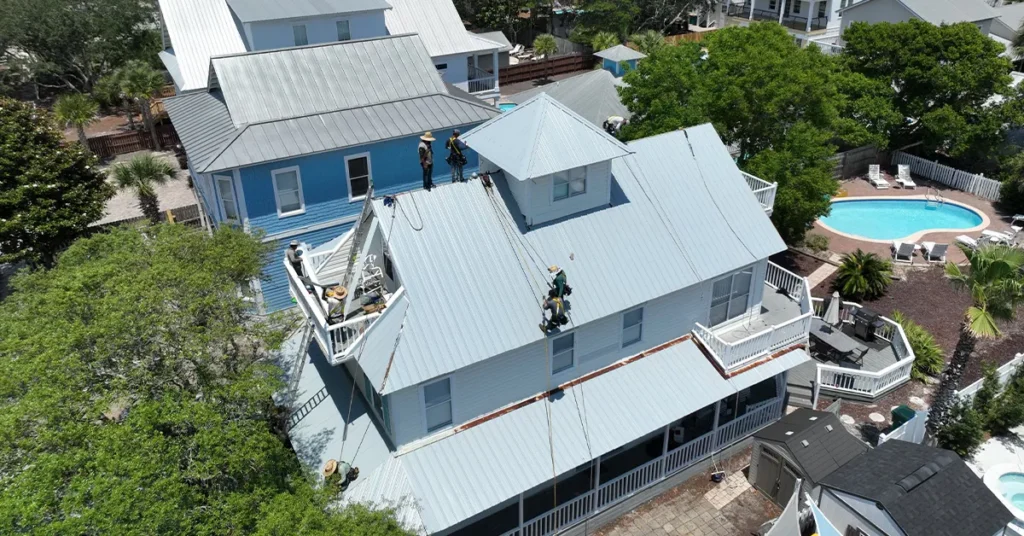
Metal roofing is a category of roofing systems in which the outer weather layer is formed from metal, most commonly steel, aluminum, copper, or zinc, rather than asphalt, wood, tile, or membrane materials. The category includes standing seam panels, corrugated and ribbed panels, and metal shingles, each with different fastening methods, performance profiles, and appropriate applications. Metal roofing systems routinely last 40 to 70 years with minimal maintenance, compared to 15 to 25 years for asphalt shingles in a coastal Florida environment. The upfront cost is higher, but the long-term value case is strong, particularly in the Florida Panhandle where salt air, UV intensity, and hurricane wind loads accelerate the degradation of asphalt-based materials.
Key Takeaways
- Metal roofing is not one product. Standing seam, corrugated panels, and metal shingles are meaningfully different systems.
- The Florida Panhandle’s coastal conditions make the longevity gap between metal and shingles wider than in other markets.
- Florida insurers increasingly favor metal roofing for wind resistance, which can affect premiums and insurability.
- Metal roofing is not zero-maintenance, but maintenance demands are significantly lower than asphalt shingles.
After years of installing roofs across the Florida Panhandle, we have seen firsthand how the combination of Gulf salt air, UV intensity, and hurricane seasons shortens the lifespan of roofs that would hold up fine in drier, lower-wind markets. That context shapes how we explain metal roofing to homeowners considering it for the first time.
What Most Homeowners Get Wrong About Metal Roofing
The most common misconception we hear is that metal roofing means one thing: the corrugated agricultural panels you see on barn roofs and commercial buildings. That image leads a lot of homeowners to dismiss metal roofing before they understand what is actually available for residential applications today.
The second misconception is almost the opposite: homeowners who have seen high-end standing seam installations assume all metal roofing is extremely expensive and out of reach for a typical residential budget. Neither picture is complete or accurate. Metal roofing spans a wide range of systems, aesthetics, and price points, and the right system for a given property depends on the roof geometry, the wind exposure, and the homeowner’s goals, not on which image comes to mind first.
What Metal Roofing Actually Is
Metal roofing is a roofing system in which the weather-resistant outer layer is metal rather than a composite or organic material. The surface does not rely on granules, bitumen, or applied coatings for its primary weather resistance. The metal itself, whether steel with a Galvalume coating, aluminum, copper, or zinc, provides the structural and weather barrier.
The material was used on commercial and agricultural buildings in the United States for well over a century before it became a common residential option. The shift to residential use happened as panel profiles evolved to suit residential architecture and as awareness grew, particularly in storm-prone and coastal states, that asphalt shingles have real performance limitations in high-wind and high-humidity environments.
The three system types homeowners in our market encounter most often are standing seam, corrugated and ribbed panels, and metal shingles. They share the metal substrate but differ significantly in how they are fastened, how they handle wind uplift, and what they look like.
Standing seam is the premium residential system. Panels run vertically from ridge to eave, and the seams between panels are raised above the panel surface and locked together. Fasteners are concealed within the seam rather than exposed to weather. This matters in the Florida Panhandle because exposed fasteners require neoprene washers to seal the penetration. Those washers degrade in UV and heat cycles, and a degraded washer is a potential leak point. Standing seam eliminates that failure mode. The concealed fastener system also provides superior wind uplift resistance, which is the relevant performance dimension in a market that sees hurricane-force winds.
Corrugated and ribbed panels, sometimes called R-panel, are exposed-fastener systems. The panel is shaped into waves or ribs that provide structural rigidity, and the fasteners penetrate through the panel surface into the substrate. These systems are less expensive than standing seam and perform well in appropriate applications. The exposed fastener consideration is real, and for properties with significant wind and salt air exposure, the trade-off relative to standing seam is worth understanding.
Metal shingles are formed panels designed to replicate the appearance of asphalt shingles, wood shakes, or tile. They provide metal longevity and wind resistance in a profile that presents as traditional residential roofing. For homeowners in communities with aesthetic preferences or HOA guidelines, metal shingles are a way to get metal performance without the industrial or modern profile of standing seam.
The System Types That Matter for Florida Homeowners
In the Florida Panhandle specifically, the conditions that matter most for metal roofing performance are wind uplift resistance, salt air resistance, and UV stability.
Wind uplift is where standing seam has the clearest advantage. The interlocking seam design distributes wind load differently than a fastener-dependent panel, and post-hurricane damage assessments consistently show standing seam as one of the better-performing residential roofing systems in high-wind events.
Salt air affects different metal substrates differently. Aluminum has a natural corrosion resistance advantage in coastal environments. Steel with a quality Galvalume coating performs well in most Florida Panhandle applications when the coating system is intact. The key variable is installation quality: correct fastener selection, proper flashing at all penetrations, and maintaining the coating system matter more than the base metal choice in most residential applications.
UV intensity in Florida is among the highest in the continental United States. Asphalt shingles degrade through UV-driven bitumen drying and granule loss. Metal does not have these failure modes. The surface does not depend on a granule layer for UV protection. This is why the lifespan gap between metal and asphalt shingles is more pronounced in Florida than in northern markets where UV exposure is lower.
Florida’s insurance market adds another dimension. Many insurers recognize metal roofing’s wind resistance in the wind mitigation inspection process. Properties with qualifying metal roofs often receive favorable underwriting treatment. Florida Statute 627.7011 allows insurers to require an inspection for roofs 15 years or older and to refuse renewal if the inspection shows less than 5 years of useful life remaining, which has accelerated replacement decisions across the Panhandle. A metal roof removes that age-based pressure entirely.
What Happens When Homeowners Skip This Research
The homeowners we see with the most regret are the ones who replaced a failing asphalt roof with another asphalt roof without considering metal, then watched that second roof start showing its age in a high-salt-air, high-UV environment faster than they expected.
The second group is homeowners who went with a metal roof but chose a contractor without specific metal roofing installation experience. Flashing failures, improperly handled thermal expansion on long panel runs, and incorrect fastener torque on exposed-fastener systems are not obvious to the homeowner at installation time, but they become obvious later, when leaks start or when panels begin working loose during wind events. A metal roof that is installed without the specific knowledge metal roofing requires does not deliver the 40-to-70-year lifespan the material is capable of.
Understanding what metal roofing is and how the system types differ is the foundation for asking the right questions when evaluating a contractor. How to choose the right metal roofing contractor is its own topic, and we cover it separately in our contractor selection guide.
The Bottom Line
Metal roofing is a long-term investment that makes strong sense for many Florida Panhandle homeowners, particularly those in coastal or near-coastal locations, those whose roof age is creating insurance pressure, and those who want to stop making the same roofing decision every 15 to 20 years. Understanding the system types, and specifically how standing seam, corrugated panels, and metal shingles differ, is what separates a good roofing decision from a regrettable one.
If you are evaluating metal roofing for your home and want a direct conversation about what makes sense for your specific property, we offer free on-site estimates with no pressure or obligation. Get Your Free Estimate
Frequently Asked Questions
What is the difference between metal roofing and a tin roof?
“Tin roof” is an informal term most homeowners use to describe any metal roof, but it is not a technical category. True tin-coated steel was a common roofing material through the early 20th century. Modern metal roofing is primarily Galvalume-coated steel, aluminum, copper, or zinc. When someone says “tin roof,” they are usually describing corrugated metal panels or standing seam steel roofing. The term does not describe a specific system type.
How long does metal roofing last in Florida?
Metal roofing systems installed properly in the Florida Panhandle routinely last 40 to 70 years. The coastal environment’s combination of salt air and UV intensity actually makes the longevity advantage over asphalt shingles more pronounced here than in northern markets. Asphalt shingle systems in our climate typically reach the end of their functional life in 15 to 25 years.
Is metal roofing louder than shingles when it rains?
A common concern, but one that does not reflect how modern metal roofing is installed. When metal roofing is installed over proper decking and underlayment, the sound difference during rain is negligible. Homeowners who notice louder rain noise typically have metal roofing installed over open framing without decking, which is a different application than standard residential installation.
Can a metal roof be installed over existing shingles?
In some cases, yes. When the existing deck is in sound condition and only one shingle layer exists, an overlay installation can be appropriate and saves the cost of tear-off. Whether an overlay is viable depends on the deck condition, which we evaluate during the estimate. We do not recommend overlays when there is any evidence of moisture damage in the existing deck, because trapping moisture beneath the new system creates problems that surface later.
Does metal roofing help with homeowners insurance in Florida?
For many Florida insurers, yes. Metal roofing’s wind resistance is recognized in the wind mitigation inspection process, and properties with qualifying metal roofs often receive favorable underwriting treatment. The specific impact depends on the insurer and the policy. Florida’s 2025 legislation permitting insurers to refuse renewal on roofs over 15 years old has made this consideration more immediate for many Panhandle homeowners.
Related Reading
- How to Choose a Metal Roofing Contractor
- Metal Roofing vs. Asphalt Shingles
- How Much Does Metal Roofing Cost?
- Metal Roof Installation